Understanding 1-Bromohexadecane: A Deep Dive into Its Journey and Modern Role
Historical Development of 1-Bromohexadecane
Curiosity drove chemists decades ago to start exploring halogenated alkanes, recognizing both their reactivity and usefulness. 1-Bromohexadecane emerged from this drive during the twentieth century, riding on the back of organic synthesis advancements and the demand for tailored surfactants and specialty intermediates. Researchers noticed that by swapping a hydrogen atom for a bromine atom on hexadecane, they could craft a tool with unique behavior. As markets opened up for specialty chemicals in personal care, agriculture, and industrial settings, 1-bromohexadecane became a useful building block, especially once manufacturing scaled up and purity improved. Older preparation methods included harsh reagents and questionable yields, but better techniques came along, not least catalyzed reactions and improved purification, letting producers keep up with tough regulatory and safety standards.
Product Overview
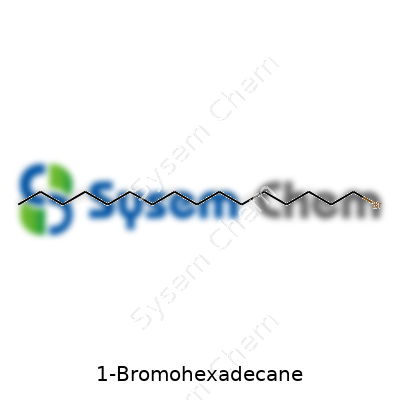
1-Bromohexadecane offers a long carbon chain with a single bromine atom at the terminal position. People turn to it for its knack for bridging hydrophobic and reactive chemical environments, acting as a base for advanced surfactants, lubricants, and intermediates in synthetic chemistry. Labs carrying out surface modification, polymer work, or specialty surfactant research often reach for it. Industry players prize it for its seamless integration into processes where chain length and the position of halogen substitution are key, supporting a lineup of products from additives to biomedical coatings. Not every molecule with a bromine behaves the same; the careful design here allows controlled downstream chemistry, giving end users reliable results.
Physical & Chemical Properties
Within the bottle, 1-bromohexadecane looks like a colorless to pale yellow oily liquid, and it comes with a faint odor. The melting point sits close to 6 °C, with a boiling point near 336 °C under atmospheric pressure. The compound’s density hovers around 1.04 g/cm³, and it dissolves poorly in water, reflecting its long hydrocarbon backbone, but mixes well with typical organic solvents like ether, chloroform, and alcohols. Chemically, it's stable under normal conditions, though exposure to high heat or open flame breaks down the molecule, releasing hydrobromic acid and carbon compounds. Bromine’s electronegativity gives the molecule a high reactivity in nucleophilic substitution, making it a prime choice for further derivatization in organic and polymer synthesis.
Technical Specifications & Labeling
Suppliers usually provide 1-bromohexadecane in sealed, amber glass bottles or drums to guard against light and oxidation. Most technical datasheets state a purity greater than 98%, with water content below 0.5%. A typical label includes the chemical name, the CAS number 112-82-3, molecular formula C16H33Br, and common hazard phrases in compliance with OSHA and GHS protocols. Each batch comes with a certificate of analysis detailing density, melting and boiling points, and the presence of impurities like dibromohexadecanes or unreacted hexadecane. Responsible manufacturers trace every batch with lot numbers, expiry dates, and storage conditions, keeping user safety and regulatory compliance upfront.
Preparation Method
Producers often start with commercially available hexadecanol or hexadecene. For most large-scale runs, a mixture of hexadecanol and hydrobromic acid, possibly in the presence of sulfuric acid, triggers a substitution reaction, yielding 1-bromohexadecane. Alternatively, hexadecene can undergo addition of HBr across the double bond, particularly with an initiator or under light catalysis. Optimizing yield calls for careful control of temperature, choice of solvent, and duration of reaction. Once the reaction wraps up, washing and distillation remove impurities, and activated carbon treatment tackles colored byproducts. These steps reveal a refined product ready for laboratory or industrial use.
Chemical Reactions & Modifications
The bromine atom clinging to the end of the carbon chain turns 1-bromohexadecane into a flexible tool for organic synthesis. Nucleophiles, such as sodium azide or amines, can replace bromine through straightforward SN2 reactions to produce azides or amines, both of which carry importance in surfactant design and pharmaceutical intermediates. Alkoxy substituents, thioethers, and other groups can be introduced in similar fashion, crafting a family of specialized molecules. Metal-catalyzed cross-coupling, for instance, the Suzuki or Heck reactions, make use of 1-bromohexadecane to create even longer and more complex hydrocarbons. Researchers exploit this modularity to unlock tailored properties in polymers or to anchor biomolecules onto solid supports.
Synonyms & Product Names
Alongside "1-bromohexadecane", catalogues and scientific texts record several alternate names: n-hexadecyl bromide, cetyl bromide, and hexadecyl bromide. Each points to the same linear, 16-carbon structure capped with a bromine atom. These synonyms often appear depending on the field, with "cetyl bromide" showing up in cosmetic and surfactant applications, reflecting the legacy underpinnings from fatty acid chemistry. Distributors and suppliers cross-list these names to help users find the correct product, keeping confusion to a minimum.
Safety & Operational Standards
Handlers of 1-bromohexadecane face clear safety considerations. The chemical can irritate the eyes, skin, and respiratory tract, and, as with many organohalides, direct contact should be avoided by sticking to gloves and eye protection. Ventilation matters, too, since heating can free toxic gases like hydrobromic acid. Workspaces need proper fume extraction and spill containment. Most safety protocols follow international standards, with process-specific training for workers. Storage too deserves care; 1-bromohexadecane responds poorly to heat and sunlight, so cool, shaded rooms win out. Waste streams must be collected as hazardous organic halides, not just dumped, to prevent soil and water contamination. These layers of safety stem from both regulatory demand and years of experience keeping personnel and environments safe.
Application Area
The reach of 1-bromohexadecane covers a surprising spread of industries. Chemical synthesis outfits harness the compound in the creation of sophisticated surfactants and quaternary ammonium compounds—ingredients frequently found in detergents, personal care products, and disinfectants. In polymer chemistry, the molecule acts as a functional initiator, opening the door to tailored chain architecture and end-group modifications. Surface modification teams graft the hydrocarbon onto particles or surfaces, tweaking wettability and interaction profiles. It also stands tall in organic synthesis as a precursor for molecules with potential pharmaceutical value. Even microelectronics research circles back to this molecule, installing it as a step in the formation of self-assembled monolayers on metals or semiconductors, which helps scientists tune interfaces in sensors or new devices.
Research & Development
Labs worldwide continue to investigate new tricks for 1-bromohexadecane, aiming for greener, more efficient reaction routes and extending the application spectrum. Directing focus to catalysis and solvent-free protocols, researchers pursue both sustainability and superior yields. Some programs zero in on material sciences, using the molecule to engineer new coatings or delivery systems with embedded biofunctionality. The compound converts easily to diverse surfactant architectures, letting teams run through a range of structure-activity relationships—fueling innovation in personal care, drug delivery, and specialty lubricants. R&D also explores the physics of self-assembly, taking advantage of the compound’s amphiphilic nature for smart materials or nanostructures.
Toxicity Research
Examining the toxicity of 1-bromohexadecane proves necessary with its growing footprint. Traditional toxicological studies show mild acute toxicity in mammals, with most cases affecting skin and mucous membranes during accidental exposure. Long-chain alkyl bromides show lower volatility than their shorter relatives, so inhalation risk drops, but persistence in tissues and the environment raises concern. Chronic exposure studies dig into the metabolic fate and possible bioaccumulation, although data gaps still exist. Researchers benchmark toxicity through in vitro studies, feeding results into safety assessments mandated for workplace and environmental protection. Countries set workplace exposure limits based on these findings and keep a watchful eye for evidence of carcinogenicity or reproductive effects—none robustly confirmed yet in 1-bromohexadecane, but the need for vigilance remains.
Future Prospects
As industries push toward sustainability and more refined molecular tools, the story of 1-bromohexadecane likely shifts. Demand for surfactants and green chemistry initiators with biodegradable and low-toxicity profiles pushes producers to explore not only cleaner production but also safer, more versatile derivatives. Research leans toward replacing hazardous reagents with milder ones, recycling catalysts, and adopting solventless chemistry to trim the environmental footprint. In specialty materials, custom-tailored alkyl bromides spark new ideas in electronics, sensing, and biomedical engineering, with 1-bromohexadecane providing a known, reliable starting point. Keeping an eye on regulations and advancing toxicology ensures the compound stays useful and safe. By adapting to new science and real-world needs, this modest-looking molecule continues to play a big role in both labs and industry.
What is 1-Bromohexadecane?
1-Bromohexadecane might sound unfamiliar to most, but it plays a key part in a lot of behind-the-scenes processes. This compound belongs to a family called alkyl halides, molecules that combine a chain of carbon atoms with a bromine atom. The “hexadecane” part signals a 16-carbon chain—these long chains let it do things short molecules can’t pull off.
How It’s Used in Industry
Brominated chemicals like this one show up in laboratories and chemical plants more regularly than most realize. Chemists favor 1-Bromohexadecane as a starting block for creating surfactants—the stuff that helps oil and water mix in detergents and shampoos. The bromine makes it easy to swap in other chemical groups, so it’s basically a building block for customizing other materials. You find its fingerprints on certain specialty waxes, coatings, and lubricants. In my time working with lab teams, we sometimes reached for this compound when we wanted to “decorate” long-chain molecules, making something that could smooth out a coating or allow a plastic to bend without breaking.
Scientists use it in making special quaternary ammonium salts, which have applications in antiseptics and preservatives. These salts also figure in the production of disinfectants, and given the events of the past few years, the value of surface and hand sanitizers doesn’t need to be explained. Sourcing robust raw materials is crucial in making sure hospitals, schools, and homes remain safe, and 1-Bromohexadecane helps lay that foundation.
Environmental and Health Safety Concerns
Working with brominated chemicals does come with risks; this chemical isn’t something you want on your skin or in your lungs. A lot of manufacturers and research teams need strong safety protocols, as exposure can irritate skin, eyes, or even damage internal organs over time. I remember my first safety talk, where trainers stressed gloves and fume hoods whenever handling alkyl bromides. Studies have shown long-chain brominated compounds can linger in the environment—once released, they take a long time to break down. The Environmental Protection Agency (EPA) and European Chemicals Agency flag these kinds of risks. Evidence links some brominated byproducts to ecological harm, especially in aquatic life and birds, which take up these substances from polluted water.
Moving Toward Safer and Greener Chemistry
People have started asking better questions about what goes into the products on their shelves and the chemicals used to make them. Shift in industry attitudes towards “green chemistry” has prompted a search for ingredients that do less harm. In college labs, we sometimes tried out alternative reactions that wouldn’t need bromine, using enzymes or milder oxidizers instead. These experiments don’t always get the same results, but the pressure is on for better solutions. Regulatory agencies urge companies to replace hazardous chemicals where they can, with some places in Europe already listing brominated substances for review or restriction.
Progress moves one step at a time. Better processes—closed systems that don’t vent toxic vapors or responsible waste disposal—make a big difference. There’s a lot to learn, and the chemical industry has miles to go, but demand for safer alternatives is driving real innovation. If you find cleaner surfactants in your soap or new coatings that don’t leach harmful byproducts, shout-outs go to the research teams and advocates pushing for smarter choices.
Final Thoughts
1-Bromohexadecane doesn’t grab headlines, but its uses touch a vast range of industrial and personal products. Paying attention to its role teaches us about the delicate balance between chemistry’s benefits and its risks. Solutions on the horizon stem from industry, policy, and personal advocacy—all working together to keep progress moving forward and harm down.
Digging into the Science
Chemistry became a lot clearer once I stopped looking at chemical names as just labels. They tell a story. Take 1-Bromohexadecane—a name that maps right onto the molecule’s structure. The “hexadecane” part signals a straight line of sixteen carbon atoms, each embraced by hydrogen atoms. Somewhere along that chain, a bromine atom hops on. The “1-bromo” piece says exactly where, so this molecule places the bromine at the very first carbon in the chain. Put all that together, you’ve got a structure that chemists write as C₁₆H₃₃Br.
Why This Matters
I’ve spent enough time in the lab to appreciate that formula. It tells you not just what’s inside, but also what you can do with it. That matters for surfactants, lubricants, and all those specialty products where even a single atom’s location makes a difference. 1-Bromohexadecane, for this reason, sees real use as a building block. Manufacturers work with it to make more complex molecules, sometimes tweaking its structure to create new materials with fresh properties.
People sometimes overlook simple molecules like these, looking for flashier compounds with bigger names. Thing is, a straightforward molecule creates a predictable foundation. Chemists know what they’re working with. If there were any mistakes in the formula, the downstream impact could be serious—think wasted resources or even safety risks. Getting that C₁₆H₃₃Br right translates into real benefits down the line.
Safety and Handling
My first encounter with 1-Bromohexadecane brought a stark reminder about safety. Bromine compounds demand respect. Even though 1-Bromohexadecane isn’t as hazardous as elemental bromine, gloves and ventilation make a difference. Skin contact can still pose problems if ignored. Working safely, plain and simple, means reading up on material safety data sheets and sticking to best practices in the lab or the plant.
Looking for Better Alternatives
One thing about bromoalkanes—I’ve seen their environmental fate draw real scrutiny. Brominated compounds sometimes resist breaking down in nature. If folks can create the same performance with less persistence or toxicity, it pays to switch. Some manufacturers hunt for greener or easily degradable substitutes for their processes. The chemical industry doesn’t stand still, so there’s always someone working to lower the footprint while keeping performance up.
Education and Transparency
A lot of confusion flows from technical jargon. C₁₆H₃₃Br might seem intimidating, but the plain meaning helps policy makers and buyers alike. Reputable sources like the PubChem database or peer-reviewed chemistry references help clear up any fuzziness. Teachers would do well to break molecules into stories, not just letters and numbers. That approach keeps young scientists curious and better equipped to handle chemicals with care, rather than just following recipes blindly.
Moving Ahead
Getting the formula right is only step one. Responsible handling, efforts to find cleaner alternatives, and a culture of safety shape the reputation of the whole chemical industry. Even a simple name like 1-Bromohexadecane opens discussion about impact, responsibility, and the need for transparency from the lab bench to the boardroom.
Getting Real about Chemical Hazards
1-Bromohexadecane lands on the bench as a colorless liquid, but it deserves respect. Skin contact burns or irritates, inhalation stings the lungs, and you don’t want it in your eyes. Early in my chemistry days, somebody in my lab splashed a similar alkyl halide and underestimated the mess it caused. After rushing to a safety shower, he learned it isn’t enough to just read the label. Real lab safety asks us to think three steps ahead.
Best Practices: Gloves, Goggles, and the Rest
I always reach for nitrile gloves before touching a bottle of 1-Bromohexadecane. Latex gloves can let some organic chemicals through in seconds. Nitrile holds up better, but even these gloves don’t last forever, so toss them after spills or extended use. Splash-proof goggles cut out the eye risk—getting brominated compounds near the eyes is a recipe for lasting damage. As for clothing, sleeves belong down and a sturdy cotton lab coat goes on. Polyesters or blends can melt into the skin if things get heated.
Ventilation: Don’t Play Around with Fumes
Every chemist has a story about chasing an escaped vapor around a cramped room. 1-Bromohexadecane isn’t a gas at room temp, but enough vapor can still build up to irritate the respiratory tract. I only open bottles of organobromine compounds inside a well-maintained fume hood. Those big fans actually move a surprising amount of air, and filter systems should get checked every few months. Tape up the sash marks: keep it at the recommended height or lower. Rushed work outside the hood usually catches up with you—sometimes in the same afternoon, sometimes ten years down the road.
Spills, Waste, and Emergency Plans
Small spills never stay small without a plan. I bookmark emergency showers and eyewashes the first day in a new lab. Bleach or strong oxidizers make things worse here; absorb spills with an inert material—kitty litter, vermiculite, or specialized pads. Scooping it up with gloves on and sealing it in a labeled bag keeps surprises out of the waste bin. Labels matter. I’ve seen enough “mystery jars” in a waste fridge to know how headaches start—write dates, hazards, and a contact name every time. Never pour 1-Bromohexadecane down any sink. Not only is it bad for the pipes, but it lands in the environment where brominated compounds stick around and can poison wildlife.
Long-Term Thinking and Health Monitoring
Labs where folks work with alkyl halides year after year often have health monitoring. Some solvents and brominated chemicals bring long-term risks—carcinogenicity, chronic respiratory problems, or neurological complaints. Periodic checkups, lung-function tests, and honest conversations with medical staff help people catch silent problems before they turn chronic. Safety training isn’t a one-off—skills dull, procedures update, fresh faces join the team. Regular refreshers keep safe habits sharp.
Building a Respectful Safety Culture
Everyone has a role, from the seasoned technician to the fresh grad student. Cultures that take shortcuts find out the true cost in time, money, or lives. If anything looks wrong—poor ventilation, missing spill kits, evaporating storage—speak up. Reporting near-misses or small mistakes means the next person doesn’t have to learn the hard way. Sharing what works and fixing what doesn’t means less pain and more discovery for everyone.
Understanding the Risks and Realities
1-Bromohexadecane belongs to the family of alkyl bromides. This chemical doesn’t scream for attention on most lab shelves, but it makes a difference in surfactant research and organic synthesis. My first encounter with it came during an internship at an industrial chemistry lab. I remember the sharp, sticky smell and the sticky residue it left on gloves. These early experiences taught me not to underestimate its health risks. Skin and eye irritation are probable. More problematic exposures lead to bronchial or nervous effects, sometimes for days.
Chemicals like 1-Bromohexadecane demand respect. Only proper storage minimizes risk. According to the Merck Index and actual safety data sheets, mishandling brings real trouble: fire hazards, vapor inhalation, and gradual container degradation. Securing storage is personal and collective responsibility in any workplace.
Safe Storage: Steps That Matter
Control access. Keep it on a high shelf or inside a locked chemical cabinet. Untrained visitors or staff do not benefit from loose access. Spills can linger on surfaces for hours, and the oily substance hides its tracks on workbenches.
Choose glass or HDPE bottles with solid, leak-proof lids. Metal containers corrode after repeated exposure to organohalides. If bottles get slick, wipe them down immediately—sloppy handling usually leads to messes no one wants to clean. I once stored solvents in a shared fridge and found a cracked cap the next week – fumes had softened the plastic cap. With a brominated solvent, always check closures twice.
Temperatures matter. I’ve seen 1-Bromohexadecane thicken at low temperatures, clouding up around 10°C, but flames and heat bring the worst hazards. Never leave it near radiators or sunlight. Room temperature stays safest, between 15–25°C. Temperature spikes stress bottles, raising risk of leaks or spontaneous chemical reactions, especially with shared equipment.
Label the bottle clearly. Avoid faded ink or hand-scrawled notes. Use chemical-resistant tape or a permanent marker and include the date received. Forgetting this step leads to “mystery bottles” — a genuine hazard for anyone in a shared environment. Routinely check expiration dates too, even if unopened; older material can degrade, making it more hazardous without notification.
Don’t Store Near Incompatible Chemicals
Shelves stacked with acids, bases, and oxidizers set the stage for disaster. Once, I witnessed a near-miss after a bottle leached and mixed with a spilled acid; the cleanup later took hours, not to mention the panic in the air. I always keep a chemical compatibility chart nearby, double-checking before adding anything new to a shelf.
Emergency Readiness and Extra Care
Accidents can still happen. I learned the hard way that eyewash stations and spill kits save time and skin. Post emergency instructions wherever chemicals live – not in a binder, but literally on the wall inside storage rooms. Make sure nitrile gloves, face shields, and splash goggles are on hand, not just written down on a PPE checklist.
There’s a reason storage protocols exist, reinforced by regular safety audits and decades of hard-learned lessons in chemical management. Good handling keeps scientific progress moving forward without risking health, equipment, or peace of mind.
A Closer Look at Its Nature
1-Bromohexadecane doesn’t make any fuss about its place in the laboratory. If you pour a bit into a beaker, you see a clear, colorless liquid. Take a whiff, and you notice a faint, chemical-like odor, nothing overpowering or harsh, but it lets you know it hasn't disappeared. It’s dense to the eye and the hand—if you’ve ever poured it, you notice it moves a bit slower than water. That checks out with its density, which sits higher than most of the liquids you encounter in everyday work, usually around 0.86 g/cm³ at room temperature.
The Gentle Boil and the Sluggish Freeze
It doesn’t rush to leave the pot if you put heat to it. The boiling point lands at about 322°C. In terms of handling, that means you have quite a temperature cushion before it vaporizes. On the flip side, its melting point comes in around 15°C. In a standard lab or even an air-conditioned room, it flows as a liquid. But leave the bottle in a cool cellar or a fridge, and it thickens up, almost turning to wax.
What You See and Smell
A lot of folks think chemical liquids like this must carry bright colors or a pungent stench. Most days, you’d walk right by 1-Bromohexadecane and not even notice it’s there. Its colorless and clear appearance means it doesn’t stand out. On benches where bottles blend into one another, labels matter. Its faint scent gives just enough warning that you’re dealing with a brominated compound, which tends to hang around in the air if you work long enough in a poorly ventilated spot.
Mixing With Everything Else
Here’s where experience comes in. If you try mixing this with water, you watch the oil slick form. It barely mixes—hydrophobic through and through. If you reach for organic solvents—things like hexane or ether—1-Bromohexadecane fits right in. This trait matters. Researchers rely on that strong non-polar nature to keep their separation processes smooth. You get clean layers and fewer headaches during extraction steps. It makes solvents selection much more calculated. The simple mistake of picking the wrong solvent wastes time and resources.
Handling and Safety in the Real World
Most folks don’t stop to think about viscosity until they're dribbling drops down a pipette and realize it pours thick, almost syrupy. You get the sense that it’ll coat glassware, making cleanup something you can’t rush. Gloves become more important, since bromine-containing chemicals can irritate skin and shouldn’t linger after a spill. Safety data demands respect—chemical burns and respiratory complaints are real. Proper storage keeps those risks in check: a cool, dry place, tightly closed, far from open flames.
Why the Properties Matter
All these details boil down to practical use. For chemists, 1-Bromohexadecane’s heavy, non-polar nature makes it a choice tool when building long-chain molecules for surfactant or organic synthesis. Just like cooking with a specialty oil, the outcome changes based on the physical traits of your ingredients. Ignore those points, the final product might flop, costing time and money. Knowledge, in this case, doesn’t just make you a more careful scientist. It saves headaches, messes, and, frankly, a lot of wasted afternoons at the bench.